
How to Deploy Pay-on-Foot Stations in Shopping Mall Parking
2026-11-25
To implement pay-on-foot stations in mall parking, begin with traffic statistics and place stations near pedestrian exits. Connect each device to your self-service auto-payment station for parking lots, and test all payment paths and stages of your launch. A self-service auto-payment terminal for parking lots allows customers to pay inside the mall before they go back to the vehicle, which keeps exit lines flowing. I prepared this guidance for parking operators, facility managers, and system integrators who need a clear approach. It includes site evaluation, hardware, integration, installation, maintenance, and supplier selection utilising ZOJE product information.
Assess the Mall and Design the Payment Flow
Study Traffic Before You Pick a Unit
Begin with numbers, not equipment catalogues. Pull a few weeks of entry/exit data and highlight the weekday peaks, weekend peaks, and holiday spikes. Average stay time, record, since a movie audience and a supermarket crowd depart in distinct waves. You may compare your own counts to the land-use demand statistics in the Institute of Transportation Engineers Parking Generation Manual (2019). Don’t forget the drivers who need aid like missing tickets or discount checks. The numbers tell you how many payment points your self-service auto-payment station for parking lots plan requires and when hours generate the biggest lineups.
Place Stations Where Visitors Already Walk
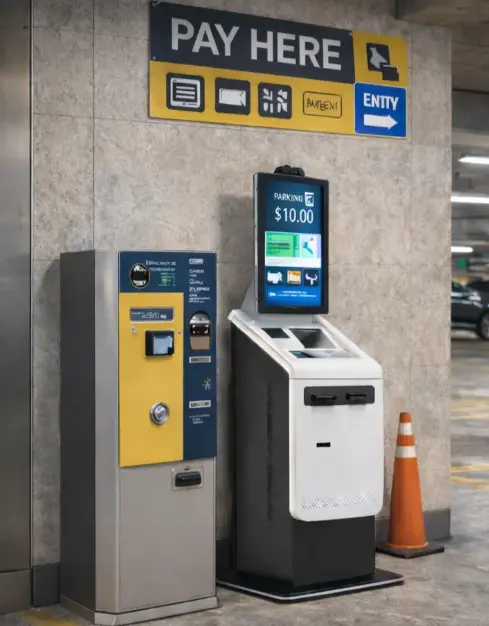
The station is in their natural path, and people pay quickest. The self-service auto-payment stations for parking lots are ideally located near mall entrances, elevator lobbies, supermarket doors, and food courts, keeping emergency exits free. Demand varies by hour and by kind of tenant, and therefore placement should reflect such patterns in mixed-use areas, as explained in the Urban Land Institute’s Shared Parking study (2020). Decent lighting, decent signage, and space for a small queue. Design for wheelchair access. The 2010 ADA Standards for Accessible Design established standards for reach range and clear floor space. If the unit is outside, erect a cover and install protective bollards.
Match the Identification Method to Your Gates
A paid-on-foot station requires a reliable mechanism to locate each car. Barcoded tickets, QR codes, and license plate data all function, but the entrance gates, stations, and exit barriers need to read the same credential. Many malls have a ticket fallback for plates the cameras misunderstand, such as filthy or older plates. Ask your provider to test plate recognition on local plates in the rain and at night before you sign. Combine the selected method, the lost-ticket rule, and the discount rules into a short spec. The document makes sure that the regulations for the self-service auto-payment station for parking lots, the gates, and the software are all the same.
Choose Hardware and Payment Features for Your Site
Core Configuration of the ZOJE Self-Service Auto-Payment Station for Parking Lots
The ZOJE self-service auto-payment pay on foot station for parking lots is based on Android 4.0 or above. It includes a receipt printer with coin and note acceptor and change machine (cycle) modules. Both cash modules are customised for your currency. ZOJE also enables OEM and ODM work, so we may change the cabinet, interface, and branding for your mall. We conduct quality tests prior to shipment: temperature testing from -30°C to +70°C, humidity validation up to 95% relative humidity, and continuous operation testing with more than 10,000 transaction cycles. Request the test records matching the model you request.
Payment Methods and Local Currency Confirmation
This station takes cash, QR code, and credit card. “So people pay different ways, and one cabinet that does all three means shorter lines and not as much need for staff help.” Cash modules are the most controversial in a project, since a note or coin module must match the local currency and the actual state of banknotes in circulation. Before placing a purchase, get written confirmation of supported US denominations, coin sizes, change logic, and card reader type. During your pilot, place folded and worn banknotes in the sample unit. This is to safeguard you against congestion when the lane is unattended.
Security, Alarm, and Optional CCTV
Security has to be taken seriously since unattended stations have cash on them. The ZOJE unit Alarm sounds when someone opens the machine by force from outside. The steel body has a three-point locking system, and the currency holding compartments are comprised of separate, lockable cassettes requiring double authorisation. CCTV surveillance is optional and is best for malls that want video recordings of cash service visits or tampering attempts. For exterior or semi-outdoor locations, ask the provider to specify the IP rating of your model. IEC 60529 specifies how such values are assessed. Choose security level by site danger, not by habit.
Integrate the Self-Service Auto-Payment Station for Parking Lots With Your Parking Management System
Connect Cameras, Barriers, and Software
A station doesn't release a vehicle by itself. It has to talk to the entrance terminal, the license plate readers, the exit barriers, and your central management software. When the motorist pays, the system should open the barrier as the vehicle comes and stamp the record as paid. ZOJE integrates with third-party management software, which is important if you already have a platform you love. Ask for interface papers early and ask that any software development kit conditions and per-lane costs be included in the estimate. Clear terms will help you avoid getting trapped into one seller later. A self-service auto-pay station for parking lots should operate with your platform, not against it.
Handle Mall Rules Without Adding Queues
Malls seldom have a flat hourly fee. Free hours at theatres, tenants validate tickets, and discounts on holidays. Implement these rules in software and test them at the station under actual conditions. ZOJE enables customised software setup for rate structures, and your discount logic may mirror your tenant agreements. Decide whether the station charges a flat rate, looks up a plate, or calls the operator for a lost ticket. Keep each screen brief since customers read rapidly and are typically carrying baggage. If your visitors speak more than one language, multilingual support is helpful.
Reconciliation, Payment Security, and Remote Control
Finance teams want clear figures. Your programme should display every transaction, cash count, and mistake per station and each lot. If the station takes cards, the configuration must comply with the PCI Data Security Standard v4.0 (PCI Security Standards Council, 2022), so check which elements your payment provider is responsible for and which parts the kiosk supplier is responsible for. If you have many lots, request central reporting and remote barrier control. Behaviour of self-service auto-payment station for parking lots while the network is down and how it syncs. Get that behaviour put into the standard.
Install, Test, and Maintain the Station
Prepare the Site and Mount the Unit
A good installation begins before delivery. Check floor layout, mounting base, cable runs, power outlet, network drop, and protective bollards. The slab should have anchor bolts. The entrance to the cash service will open all the way. ZOJE can provide conventional units in 5-7 days and customised units in 10-15 days. We facilitate delivery by sea and air on DDU and DDP conditions. Formal quote will apply to Lead time, MOQ, and certifications. The electricians and network team should complete their work before the unit arrives, so the technicians simply have to install, connect, and set up the self-service auto-payment station for parking lots.
Test Every Payment Path Before Opening
Make a test sheet. Run it on every unit. Cash payment with change, QR code payment, credit card payment, lost ticket, discount confirmation, receipt printing, and barrier release. Test failures: unhook the network cable, cut the power, insert a worn note. In a supervised test, open the door without permission to make sure the alarm sounds and workers get it. Train workers on how to replenish paper and remove a clog. A small soft launch with a staff person present detects errors while they are still affordable to rectify. For parking lots, install a new self-service pay on foot station; duplicate the sheet.
Plan Maintenance and Support
Unattended lanes rely on swift repairs. Set up a weekly schedule for cleaning the screen, checking the printer, refilling paper, and checking cash modules. Have extra parts on hand, particularly those for the printer and cash module. ZOJE offers pre-installation consulting, installation advice and training, 24/7 worldwide technical support at info@zoje-tech.com, a two-year guarantee, and yearly on-site visits for maintenance and updates. Whichever provider you choose, get response timeframes and parts replacement conditions in writing. When a lane stops at 11 p.m., clear service level is more important than a big feature list.
Compare Options, Judge Costs, and Roll Out the Self-Service Auto-Payment Station for Parking Lots in Phases
Compare Payment Models
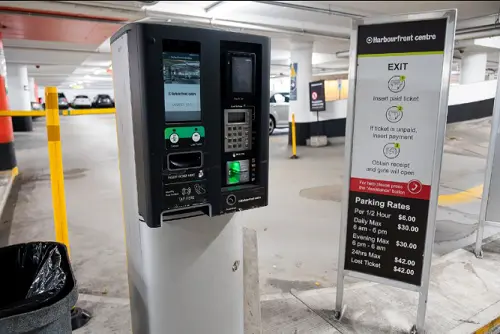
Attendant booths, mobile-only payment, and self-service stations all have their positives and negatives. Booths handle exceptions effectively but add labour to every shift. Mobile payment is rapid, but those without a smartphone or mobile data will require another way. One cabinet consolidates cash, QR code, and card for a self-service auto-pay system for parking lots, so personnel only handle exceptions. Many operators mix stations in the mall with a staffed support option for edge scenarios. Choose based on your visitor mix, not trend, and re-verify the mix after a few months of live data.
Judge Total Cost and Return
Don’t just compare unit prices; compare total cost. Hardware, software licensing, payment fees, civil work, electrical and network preparation, installation, training, spare parts, and servicing. Then outline the quantifiable savings: fewer booth hours, less time with cash, less paper for tickets, less contested fines. Calculate it using your actual labour rates and number of transactions, not a generic payback statement. Ask for detailed pricing, lead times, MOQ, warranty conditions, and support levels from each supplier. ZOJE goods conform to ISO 9001:2015 quality management requirements, and we have many patent certifications.
Pilot First, Then Expand
Begin with one batch or one exit zone for 4-8 weeks. Measure payment time, unsuccessful transactions, jam count, queue length, and support calls. Fix the issues and place the next purchase. Phased orders also allow you to verify the quality of delivery and service before committing a greater expenditure. When you get to the second lot, you use the same standard, the same test sheet, the same staff training. Look at data quarterly and change where stations are placed, payment screens, and maintenance intervals. Steady rollout is better than hasty rollout, since every lane relies on the station operating.
Conclusion
A self-service auto-payment station for parking lots in a shopping mall is most successful when each step is built on the previous one. The number and position of stations is determined by traffic logs and peak departure data. The identification technique must match entrance gates and exit barriers. Daily stability depends on hardware choices, notably cash modules, local currency fitment, card & QR payment, tamper alarm & optional CCTV. Payments, discounts, and financing are kept constant with the integration of cameras, obstacles, validation rules, and reporting software. Uptime is secured by careful installation, complete payment testing and a maintenance plan. Total cost of ownership is a fairer comparison than unit pricing. The pilot checks the findings against the mall’s own statistics before rolling it out more widely.
FAQ
1. How does a pay-on-foot station work?
The visitor scans a parking ticket or QR code at the station. The system calculates the fee, accepts cash, QR code, or credit card payment, and prints a receipt. The software then marks the record as paid, so the exit barrier opens when the car arrives.
2. How many stations does a mall need?
The answer depends on peak exit volume, walking routes, and payment time, not on parking-space count alone. Use entry and exit logs to estimate demand, then confirm the number with pilot results before ordering more units.
3. Can ZOJE customize the station?
Yes. ZOJE supports OEM and ODM work, customized coin and note modules, branded interfaces, and integration with third-party management software. Confirm US currency support in writing before you place an order.
Request a Self-Service Auto-Payment Station for Parking Lots Quote From ZOJE
Ready to plan your mall project? ZOJE is a self-service auto-payment station for parking lots manufacturer in Shenzhen, offering OEM and ODM support, ISO 9001:2015 compliance, a two-year warranty, and 24/7 global technical support. Standard units ship in 5–7 days, and customized units ship in 10–15 days. Send your site details and currency needs to info@zoje-tech.com for product information.
References
1. Parking Generation Manual, 5th Edition, Institute of Transportation Engineers, 2019
2. Shared Parking, 3rd Edition, Urban Land Institute, 2020
3. 2010 ADA Standards for Accessible Design, U.S. Department of Justice, 2010
4. Payment Card Industry Data Security Standard, Version 4.0, PCI Security Standards Council, 2022
5. IEC 60529: Degrees of Protection Provided by Enclosures (IP Code), International Electrotechnical Commission, 2013
6. ISO 9001:2015 Quality Management Systems — Requirements, International Organization for Standardization, 2015

Send Inquiry
You may like