
Is High-Wing Speed Gate Turnstile Suitable for Airports?
2026-05-15
Entry control systems must keep people safe and allow easy passage through airports. A new airport entry management system is the High-Wing Speed Gate Turnstile for Fast Access. While screening 35 to 40 travelers every minute, its 1.2 to 1.8-meter hurdles prevent unauthorized entry. This solution overcomes airport-specific issues, unlike waist-high obstacles that can be jumped or crawled beneath. It prevents tailgating with enhanced infrared detection, maintains throughput during peak boarding periods, and interacts with biometric verification systems. The answer to whether these devices are acceptable depends on how they fulfill aviation security criteria and improve terminal operations.
Understanding High-Wing Speed Gate Turnstiles
What Defines a High-Wing Speed Gate System
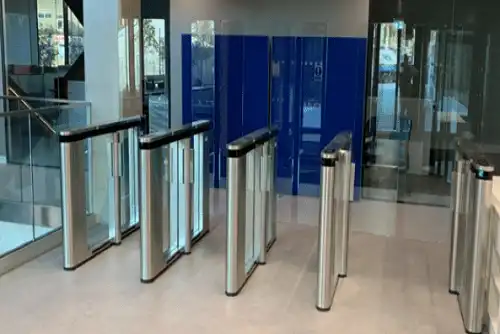
High-Wing Speed Gate Turnstiles employ motorized glass or plastic panels that protrude considerably above waist level to provide a sturdy barrier. The basic mechanical construction has brushless DC motors that open the door in 0.2 seconds and precise sensors that detect unauthorized entry. These devices lack the "jump-over" shortcoming of tripod or waist-height flap barriers, making them unique. In modern units, infrared beam arrays scan the passing lane, motor current detecting systems halt wing movement when resistance is encountered, and soft torque algorithms rapidly reverse motion when obstructions are detected. This safety design maintains the closing force below 60 Newtons, meeting EN 16005 safety regulations for automated pedestrian gates and ensuring security.
Core Components and Operational Logic
High-wing aircraft control systems include many crucial subsystems. RS485 and TCP/IP allow RFID badges, QR codes, fingerprint scanners, and facial recognition cameras to communicate with the access verification interface. This lets airport administrators utilize multi-factor authentication in separate security zones. Tailgating-prevention logic is a victory for airport applications. The device creates passing lane detecting arrays using parallel infrared beam pairs. When two persons attempt to pass with the same permit, the system sounds a warning and pauses the gate from shutting until the lane is clear. This functionality addresses TSA and foreign aviation regulated entry point security demands. Emergency response enforces life safety laws. The wings automatically fold back into their cabinets when a fire alarm or power outage sounds, allowing people to escape. The NFPA 101 Life Safety Code requires this fail-safe construction in public spaces like airport hubs.
Material and Build Quality Considerations
Airports must be robust since they are often utilized and exposed to various weather conditions. High-quality models include impact-rated tempered safety glass and stainless steel 304 or 316 frames that don't corrode in humid airport settings near the seaside. Wing mounting systems have precision bearings that endure five million working cycles. Cabinets commonly employ IP54 powder-coated steel or aluminum alloy housings. These shield the electronics from accidental water contact and dust during terminal cleaning. These material requirements affect long-term maintenance costs and system reliability in severe airport operating scenarios.
Why Fast Access Control Is Critical in Airports
Peak Period Traffic Management Challenges
Airport traffic fluctuates often. Traffic congestion at entrance check points are caused by morning and evening departures and arrivals. impede-response turnstiles and human verification impede security screening and boarding by creating airport-wide lineups. High-Wing Speed Gate Turnstiles, which move 35–40 persons per minute, address bottlenecks. Comparative study demonstrates measurable changes. Due to the mechanism's cycling duration, full-height spinning gates can only let 15 to 20 persons through per minute, compared to 20 to 25 for tripod turnstiles. Speed differences matter when numerous foreign aircraft arrive at the same time during customs and immigration procedures.
Security Risk Mitigation Requirements
Aviation security requires ID and clearance to enter clean areas following passenger screening checks. Wing barriers hinder unauthorized entry since they are higher than waist-height obstacles. A defense-in-depth design includes this physical security layer and computer verification methods. Airport security evaluations have shown that outdated access control systems are less safe. Regulators are investigating people leaping over or fitting beneath flap barriers. Due of their extended vertical reach, high-wing designs remove certain assault avenues. This prevents anybody from passing without activating detecting systems.
Integration with Modern Verification Technologies
Modern airports verify IDs via biometric facial recognition, iris scanning, and digital boarding passes. Access hardware must connect to many verification backends for these projects to succeed. High-Wing Speed Gate Turnstiles use open protocol communication and changeable input/output code to support this environment. The ZOJE BST200 model integrates RFID, QR code, fingerprint, and facial recognition interfaces. Airport operators may employ a single hardware platform with adjustable software settings for each security zone to handle credentials at staff entrances, secure area boundaries, and luxury client lounges.
Comparing High-Wing Speed Gate Turnstiles with Other Turnstile Types for Airport Use
Security Performance Analysis
Airports prioritize safety and efficient passenger flow when selecting turnstiles, such as the High-Wing Speed Gate Turnstile for Fast Access. Floor-to-ceiling barriers at full-height turnstiles give the most physical protection but make some tasks difficult. Due of their lengthy rotation cycles and industrial appearance, they are unsuited for passenger areas. Building design should include customer experience. High-Wing Speed Gate Turnstiles are both attractive and secure. Although the 1.2 to 1.8-meter barrier height prevents casual walking around it, it nevertheless boasts wide vistas and a contemporary airport design. Infrared sensor grids provide tailgating protection like full-height installations without taking up space or slowing flow. Old airport security technologies like flap barriers and tripod turnstiles are becoming obsolete. Their waist-level barriers don't dissuade committed tailgaters, and their simplistic design lacks sensors for reliable anti-tailgating detection. Airport systems fail more often because travelers misuse them and the structures weren't meant to survive.
Spatial and Architectural Considerations
Terminal design must include security, traffic flow, comfort, and appearance. Full-height turnstiles need 1.2 to 1.5 meters of lane width and mechanical clearance zones, taking up valuable airport floor space. Their size and design make them scary, which contradicts airports' open and pleasant feel. More High-Wing Speed Gate Turnstiles may be erected in busy stop locations since they function within 600 to 900 millimeter lane widths. The transparent glass wings maintain a clear vision over security lines at airports for navigation and security. In pre-current security systems, spatial efficiency is crucial when introducing access control. When designing a place, consider accessibility. Wheelchair users and others with mobility issues must have access to barrier-free passages under the ADA. Separate parallel gates for full-height turnstiles complicate traffic control and increase installation costs. High wing installations can manage dedicated broad lanes with synchronized wings.
Lifecycle Cost and Maintenance Requirements
When buying, customers should consider the whole cost of ownership, not simply the initial financial cost. Full-height turnstiles need a lot of mechanical maintenance due to their intricate rotating mechanisms and hefty loads. Service periods are every three months, while airport duty rounds need part replacement every 18–24 months. High-Wing Speed Gate Turnstiles need repairs every six months instead of annually due to brushless motor technology and simpler wing motion. The simpler machines need fewer components and can be maintained faster, reducing company downtime. Different maintenance expenditures might add up to 40% of the initial equipment investment over 10 years. Compare airport systems to see cost changes. Full-height turnstiles cost $1,200 a year to maintain, whereas High -Wing Speed Gate Turnstiles cost $720. This is because high-wing gates need less maintenance and employ fewer parts. These disparities affect procurement techniques when dispersed over dozens of access sites.
Installation and Maintenance Best Practices for Airport Deployment
Site Assessment and Planning Requirements
A successful airport installation begins with a detailed site study of the building's structure, electrical, and network connections. The floor must support 80 to 120 kg of fixed weight per lane and dynamic forces during operation. Check anchor bolt placement on concrete foundations, particularly if they were installed later and the finishes cover the rebar. Electrical demands usually need 110–240 VAC single-phase electricity with circuit protection. Each gate lane needs 100–150 watts while not in use and 300 watts when the wings move. Power distribution schemes must accommodate for many lanes operating at once during heavy traffic to minimize circuit overload. Entry control platforms and building management systems may be connected to network infrastructure. Best practices recommend two network paths: principal Ethernet lines for real-time transactions and backup RS485 serial connections for basic functionality when the main network fails. Redundancy ensures security functions continue if portions of the system fail.
Integration with Airport Systems
Modern airports use complex IT systems for security, flight information, luggage handling, and building automation. High-Wing Speed Gate Turnstiles must operate well with these platforms for practicality. The ZOJE BST200 may be monitored and managed in real time by security control centers via TCP/IP. Integration testing should ensure that credential verification routines function with all authentication methods. At the approach phase, biometric facial recognition systems must synchronize passenger photos with the High-Wing Speed Gate Turnstile for Fast Access before activating the wings. RFID badge scanners must be adjusted to read tags in the radio field without slowing people down. Integrating emergency equipment is crucial to safety. The turnstile logic must hear and respond to fire alarms, emergency evacuation notifications, and security staff's manual override commands. These events should be replicated during testing to ensure the fail-safe system works and escape routes are clear within time restrictions.
Routine Maintenance and Service Programs
Preventative maintenance schedules maintain reliability and assure coverage. Every six months, the service crew should inspect the wing attachment hardware mechanical parts, oil the pivot bearings, calibrate the infrared sensor arrays, and test the safety system. Mission-critical installations need controlled deployment and rollback of software modifications that address security flaws or introduce new functionality. Cleaning processes maintain sensor appearance and function. Airports lose their high-end appeal when glass wing surfaces become dusty and fingerprinted. Clean surfaces weekly using non-abrasive methods to prevent buildup that blocks the infrared beam across the passing lane. Diagnostic monitoring tools alert you to issues before they disrupt work. Advanced systems communicate operational data to centralized management platforms that monitor transactions, failures, and component health. This information helps predictive maintenance plans delay part replacement until designated service windows, avoiding unexpected issues during busy periods.
OEM Partnership and Technical Support
Choose equipment vendors with solid support infrastructure for airport installations, where downtime impacts security and customer experience. ZOJE Technology and its local service partners provide 24/7 global technical assistance and can react fast. Replacement parts and repairs for manufacturing defects are covered by the two-year warranty, safeguarding the original investment. Working with OEMs enables you tailor adjustments to each airport. Terminal personnel must adjust lane widths to accommodate checkpoints, polish cabinets to building requirements, and modify security protocol-compliant software logic. ZOJE's OEM and ODM services allow these adjustments while maintaining the system's reliability engineering proof. Authorized marketing channels verify equipment and guarantee. Airport procurement teams should verify supplier names and manufacturer verification to prevent buying unsafe, unsupported items. Well-documented supply chains are crucial for overseas projects delivering equipment to many countries.
Recommendations and Procurement Guidance for Airport Procurement Managers
Defining Requirement Specifications
The initial step in purchasing airport access control is listing all your practical demands in many categories. Throughput capacity should be based on peak season passenger flow statistics with space for development. The categorization of security zones determines the sensitivity and identification required for each installation location. Floor area, ceiling height, and architectural finishes effect tool selection. Standard product settings may need to be adjusted for upgrades or design integration.High Speed Gate Turnstile for Fast AccessProcurement documents should include modifications and standard features to balance cost and delivery time. Regulatory compliance criteria vary by region and security. Border protection and transportation security governments regulate customs and immigration at airports worldwide. TSA, ICAO, and local life safety system construction codes should be referenced in the procurement criteria.
Evaluating Supplier Capabilities
Choose a provider based on their professional expertise, service facilities, and technology deployment in other airports. Flight security demands are better understood by high-security access control firms than basic hardware providers, especially when deploying solutions such as High-Wing Speed Gate Turnstile for Fast Access in high-traffic terminals. Request case studies with comparable configurations and customer references who are willing to discuss the installation. Manufacturing quality certifications demonstrate process control and consistent results. ISO 9001:2015 certification confirms your commitment to quality management systems that monitor planning, development, and testing. Patents demonstrate technological innovation and engineering expenditure beyond ordinary manufacturing. Service abilities must fulfill airport operating demands for rapid replies and little downtime. The supplier's expert hotline, spare parts inventory locations, and field service coverage should be checked. Because airport security projects are urgent, ZOJE provides standard delivery in 5–7 days and qualified support 24/7.
Negotiating Commercial Terms
Airports frequently purchase in bulk, allowing for volume pricing negotiations and attractive conditions. To fully evaluate offers, get complete quotations that include hardware, customization, installation, and additional warranty options. Understanding how parts are divided down helps you negotiate supplier rates. Capital projects with several phases or terminal modifications need meticulous payment and supply strategies. Buyers are protected and sellers have appropriate cash flow with milestone-based payment agreements that match delivery, installation, and acceptance testing. Foreign agreements where the parties don't currently conduct business might benefit from letters of credit or payment commitments. Warranty conditions should be carefully reviewed following typical coverage periods. Make it clear what defects are covered and what needs frequent replacement due to wear and tear. Find out how long the guarantee service will react and whether there are loaner tools to maintain security while repairs take time. The ZOJE two-year warranty covers basic concerns, while service plans provide lifetime support.
Bulk Purchasing and Standardization Benefits
Airport owners with many locations or staged expansion initiatives benefit from platform standardization in training, part tracking, and maintenance. Sticking with one manufacturer for all your airport's High-Wing Speed Gate Turnstiles saves money on bulk purchases and simplifies operations. Standardization lets you strategically position additional pieces. Workers stock standard parts for all access points instead than storing separate supply. This strategy reduces inventory costs and speeds up maintenance by making replacement parts more accessible. Maintenance staff and security guards operate more effectively using the same tool bases. One set of training materials may cover all installations instead of individual certifications for each product. Airport managers who must comply with union contracts requiring new system training benefit from this standardization.

Conclusion
High-Wing Speed Gate Turnstile for Fast Access solutions represent some of the most effective entrance control technologies for safe and efficient airports. High-Wing Speed Gate Turnstiles address aircraft security needs by handling 35 to 40 passengers per minute while preventing unauthorized entry. These devices can be connected with biometric systems, fulfill international safety requirements, and have higher lifespan economics than earlier barrier technologies, making them superior airport investments. The ZOJE BST200 shows how purpose-built design, extensive customizable support, and a solid service infrastructure can provide airport-grade solutions. When buying teams are considering choices for developing or renovating terminals, they should prioritize vendors with airline industry knowledge and the technical capabilities to address complex integration demands throughout the lifespan.
FAQ
1. Can high-wing speed gates handle the number of people who come through big foreign airports?
Busy airports benefit from High-Wing Speed Gate Turnstiles' 35–40 persons per minute capacity. They have substantially greater flow than tripod or flap barrier turnstiles. A correctly built system with adequate lanes keeps traffic flowing without jams when many people leave. The most crucial factor is matching the number of lanes to the number of road users during design periods. One lane per 500–600 peak-hour people is typical.
2. How do these turnstiles work with fingerprint boarding technology and TSA PreCheck?
Modern High-Wing Speed Gate Turnstiles communicate with complicated passenger processing systems using standard protocols. The ZOJE BST200 connects to face recognition, RFID, and QR code scanners via TCP/IP and RS485 ports. They work at TSA PreCheck lanes and foreign departure gates since they are so versatile. Multiple verification sources may simultaneously deliver control logic permission signals. This enables high-security multi-factor authentication.
3. What happens when there is a disaster and the power goes out?
Emergency fail-safe activities are required by safety requirements. High-Wing Speed Gate Turnstiles withdraw their barrier wings automatically when they hear a fire alert or lose power, allowing people to escape. The NFPA 101 Life Safety Code approves this approach for public gatherings. Battery backup systems maintain basic security tracking during brief power outages. When the power is out for a lengthy period, the emergency open mode prioritizes passenger safety above access restriction.
Partner with ZOJE for Airport-Grade Access Control Solutions
The security system at airports needs High-Wing Speed Gate Turnstile for Fast Access options that are built to last and work well. ZOJE Technology offers tested products that can handle 35 to 40 people per minute and include full biometric integration. Their manufacturing is ISO 9001:2015 approved, and they can also make products to fit the needs of OEMs. Our BST200 model is used by airports all over the world thanks to relationships with approved suppliers and makers that offer low prices, regular shipping in 5 to 7 days, and expert support 24 hours a day, 7 days a week.
Our open approach to airport projects, along with our thorough site assessment services and integration planning that makes sure rollout goes smoothly, helps procurement managers. Whether you're replacing old systems or adding new security checkpoints, our team can help you with custom solutions that meet your specific business needs. The full two-year warranty and world repair network will protect your investment for the whole life of the system. Reach out to info@zoje-tech.com to talk to our technology experts about your airport entry control needs. You can look at case studies from similar airport parking lots, read full specs, and get quotes that are specific to your project at zoje-parking.com. ZOJE's production know-how and partnership focus on customer satisfaction make the secure infrastructure your airport needs.
References
1. Transportation Security Administration. "Access Control Systems for Airport Secured Areas: Design and Implementation Guidelines." TSA Security Infrastructure Standards, 2021.
2. International Civil Aviation Organization. "Annex 17 to the Convention on International Civil Aviation: Security - Safeguarding International Civil Aviation Against Acts of Unlawful Interference." ICAO Security Standards and Recommended Practices, 2020.
3. American Society for Industrial Security. "Physical Security Principles for Airport Terminal Design." ASIS International Aviation Security Council Guidelines, 2019.
4. National Fire Protection Association. "NFPA 101: Life Safety Code - Requirements for Means of Egress Components in Public Assembly Occupancies." NFPA Standards Council, 2021 Edition.
5. Airport Cooperative Research Program. "Guidebook for Airport Terminal Access Control Systems: Selection, Procurement, and Implementation." Transportation Research Board Special Report 315, 2018.
6. European Committee for Standardization. "EN 16005: Power Operated Pedestrian Doorsets - Safety in Use - Requirements and Test Methods." CEN Technical Committee Standards for Automated Gates, 2020.

Send Inquiry
You may like


Related Industry Knowledge
- What Is Security Anti-Collsion Barrier? Key Features
- High-Speed Access Control Turnstile Gate Features
- Best Bridge-Style Tripod Turnstile for Commercial Entry
- Interlocking Full-Height Turnstile Gate Benefits
- What Is License Plate Recognition and How It Works in 2026?
- Commercial Parking Efficiency Boost with ANPR System Explained
- What Is an Integratable LPR Parking System?
- Developer-friendly ANPR Software: Complete Integration Guide
- How to Customize Localized Plate Recognition for Regional License Plates?
- Integratable Parking Software vs Standalone Systems: Which Is Better?