
Smart Access Control: Pedestrian Turnstile Solutions for Airports
2026-05-18
By 2026, the market scale of pedestrian turnstiles in industrial scenarios has reached 4.26 billion RMB, marking a robust 18.7% year-on-year growth. Concurrently, rail transit and airport projects are expanding significantly. As a prime example of a "high-security, high-traffic" environment, airports present unique challenges.
The demand for "safe, efficient, and stable" pedestrian access management is escalating rapidly.
Traditional, standalone manual security checks and basic gate equipment are no longer sufficient to meet the comprehensive requirements of modern airports in key areas such as:
· Peak Flow Efficiency: Managing massive crowds smoothly during peak travel hours.
· Multi-Zone Access Control: Implementing precise permission management across different airport zones.
· Passenger Experience: Enhancing the overall travel journey with seamless transit.
· Anti-Tailgating Security: Preventing unauthorized access and tailgating attempts strictly.
· Intelligent Integration: Linking seamlessly with broader airport smart systems and data networks.
· International Image: Elevating the airport's profile with modern, premium infrastructure.
· Long-Term Stability: Ensuring robust, continuous, and reliable operation over extensive periods.
Today, an increasing number of airport projects are adopting smarter pedestrian channel solutions to achieve a comprehensive upgrade of their access control systems.
Unlike standard commercial office projects, an airport transit system must not only guarantee high-efficiency throughput but also satisfy complex security management logics and multi-zone integration requirements.
Typical airport application scenarios include:
· Terminal Employee Access Channels: Securing the fast-track lanes for airport and airline staff.
· VIP & CIP Lounges / Fast Lanes: Providing premium, frictionless access for high-value passengers.
· Customs & Border Control Zones: Integrating with biometric systems for strict identity verification.
· Pre-Security Checkpoints: Managing initial passenger entry and boarding pass verification.
· Boarding Gate Areas: Facilitating self-service boarding (e-Gates) to speed up departures.
· Staff Office & Operations Areas: Restricting access to sensitive administrative and control rooms.
· Baggage Handling & Restricted Zones: Guaranteeing high-level security for critical back-of-house operations.
· Metro & Intermodal Transit Hubs: Connecting seamless passenger flow between rail transit and the airport.
· Parking Structure Connectors: Securing pedestrian access points leading from parking lots to terminals.
"One size does not fit all." Different airport functional zones demand highly customized specifications for pedestrian access equipment.

During implementation, airport projects typically face the following core challenges:
1. High Passenger Volume During Peak Hours
Airports experience sustained, massive traffic flows during peak travel periods. If the access equipment operates with insufficient efficiency, it can easily lead to:
· Queue Congestion: Severe bottlenecks at critical checkpoints.
· Transit Delays: Slower passenger processing times affecting schedules.
· Increased Security Pressure: Added stress on security personnel and screening lines.
· Degraded Passenger Experience: Reduced satisfaction during the travel journey.

Consequently, airport projects demand exceptionally high standards for the opening response speed, continuous throughput capacity, and long-term stability of channel equipment.
2. Rigorous Security Requirements
As a high-level public security environment, airports require an access control system equipped with advanced safety features, including:
· Anti-Tailgating Detection: Preventing unauthorized entry behind valid users.
· Anti-Reverse Passage: Blocking traffic from moving in the wrong direction.
· Illegal Intrusion Alarms: Triggering immediate alerts for forced or unauthorized access.
· Multi-Level Access Management: Implementing precise permission hierarchies for different zones.
· Security Platform Integration: Linking seamlessly with the airport's centralized security systems.
· Real-Time Data Uploads: Ensuring instant synchronization for tracking and auditing.
Furthermore, international airport projects often demand compliance with even stricter security regulations and global certification standards.

3. 24/7 Continuous Operation
Airport access control equipment typically demands long-term, non-stop operation. This means that variables such as:
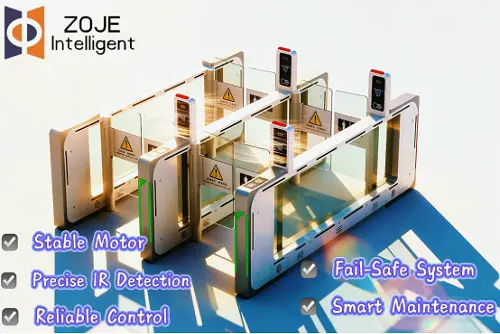
· Motor Stability: Ensuring durable mechanical drive performance.
· Infrared Sensor Precision: Maintaining accurate pedestrian detection without degradation.
· Control System Reliability: Guaranteeing seamless software and hardware execution.
· Failure Rate Control: Minimizing operational downtime strictly.
· Maintenance Convenience: Allowing fast, hassle-free servicing and parts replacement.
All directly impact the airport's daily operations. For large-scale airport projects, equipment stability is far more critical than upfront cost.
4. Seamless Integration with Multiple Systems
Modern airport pedestrian channel systems must interface and sync seamlessly with a wide range of operational platforms, including:
· Facial Recognition & Biometric Systems: For secure and automated identity verification.
· Boarding Pass Verification Systems: Facilitating self-service boarding and pre-security checks.
· RFID & Barcode Readers: Supporting various ticketing, staff ID, and scanning methods.
· Centralized Access Control Platforms: Aligning with the overall facility management logic.
· Visitor Management Systems (VMS): Managing temporary contractors and guest access.
· CCTV & Security Monitoring Platforms: Providing synchronized video capture and threat alerts.
· Fire Alarm & Emergency Systems: Ensuring instant, automatic gate release during emergencies.
Consequently, the open protocol capabilities and cross-platform compatibility of the hardware are absolutely critical.

As a complex transportation hub with high security, heavy passenger volumes, and multi-business models, airports require completely different turnstile specifications depending on the zone. Leveraging years of proven airport project experience, ZOJE Intelligent customizes and delivers tailored gate selection recommendations across 9 core airport scenarios.

Summary of Gate Selection Principles
Selecting pedestrian gates for airports is a dynamic balance among four critical factors: Security Level, Throughput Efficiency, Environmental Adaptability, and User Experience. We recommend adhering to the following core principles:
· Tiered Deployment Based on Security Levels: High-security zones like Customs/Border Control and Baggage Handling must deploy Full-Height Turnstiles or high-security Speed Gates. Staff access and office areas can utilize standard Swing Gates or tripod turnstiles. Meanwhile, public passenger zones (pre-security, boarding gates, transit hubs) must prioritize wide lanes and rapid throughput capacity.
· Focus on "Luggage-Friendly" Design: In all areas where passengers carry luggage, the lane width should not be less than 900mm (1000–1200mm is highly recommended). Additionally, avoid narrow flap gates that easily trap or obstruct suitcases.
· Prioritize Integration and Interoperability: Airport gates rarely operate in
isolation. It is vital to confirm interface protocols with the Departure Control System (DCS), security scanners, access control managers, baggage systems, or metro ticketing platforms beforehand. Always choose brands with robust, open API capabilities.
· Demand Extreme Durability and Maintainability: With airports requiring 24/7 non-stop operation, the gate motor lifespan (MTBF) should reach at least 5 million cycles. Furthermore, internal components must feature a modular design to allow rapid on-site replacement and minimize downtime.
Modern airport projects have upgraded their requirements for pedestrian access systems from "basic transit equipment" to intelligent, highly secure, and systematized turnkey solutions.
A mature airport pedestrian access solution demands far more than just stable and reliable hardware; it inherently requires:
· Extensive Project Experience: A proven track record in high-stakes aviation deployments.
· Multi-System Integration Capabilities: Seamless interoperability with complex airport platforms.
· Customized R&D & Development: The flexibility to tailor software and hardware to specific project needs.
· Long-Cycle Delivery Reliability: Robust supply chain and project management for extended timelines.
· Global Technical Support: Dependable, round-the-clock service and engineering support worldwide.
For these 9 core scenarios, ZOJE Intelligent offers a comprehensive product matrix ranging from slim speed gates to high-security full-height turnstiles. We provide an integrated, site-specific configuration blueprint covering "Scenario - Hardware - Interface - Deployment" for every critical zone.
Send Inquiry
You may like