
Green Light, Red Light: How Occupancy Indicators Reduce Search Time
2026-11-19
Drivers who see occupancy signs in green and red may find a space more quickly, knowing where to go before they start searching. At every decision point, there is an indoor parking guidance display screen panel for live space counts and direction arrows. A motorist finds an open zone and goes right there instead of driving all the aisles. Sensors sense individual bays, a controller updates the signs, and the driver responds to a simple colour indication. This handbook is for owners of facilities, parking operators, and building-systems contractors who want to know how the technology works, what to look for before you purchase, and how to validate findings.
Why Drivers Waste Time in Indoor Parking Facilities
The Real Cost of Circling
Drivers who can't see an open area keep driving until they see one. The behaviour leads to ramp waits, wastage of gasoline, and exhaust fumes in confined air, underground garages, malls, hospitals, airports, and office buildings. In a 2006 analysis for Transport Policy, Donald Shoup reviewed 16 studies of cruising for curb parking. The study indicated that around 30 percent of the traffic in the areas investigated was automobiles hunting for a spot. Those studies examined roadways, not garages, but the pattern will seem recognisable to anybody who has seen a full parking deck on a busy Saturday. Frustration comes quickly.
Why Static Signs Fall Short
A static sign that says "Level 3" doesn't notify a motorist whether Level 3 has any available bays. Then staff wave vehicles on or respond to radio calls about where space remains, distracting them from other responsibilities. Occupancy also varies over the day. The hospital garage fills up during morning appointments, while the office garage empties out after five. Drivers assume, and every inaccurate assumption increases distance, noise, and danger to pedestrians. Live signage helps narrow the gap, since they alter as a vehicle enters or departs a bay. Indoor Parking guidance display screens display current information when the driver needs it, instead of guessing.
A Practical Fix Without New Construction
Most garages don't require extra concrete. They need to make greater use of the space they currently have. Instead of stacking up at the entry, automobiles in a show spread out throughout floors when sending traffic to open zones. That cuts the time each vehicle spends on ramps and aisles and frees up lane space. Adding signs, sensors, and a controller is far less expensive than creating an additional level, and installers may phase the job by zone. For building-systems contractors, the indoor parking guidance display screen is a specified low-voltage scope with unambiguous testing processes. Drivers get an upgrade notification on their first visit.
What an Indoor Parking Guidance Display Screen Is and How It Works
Definition and Display Formats
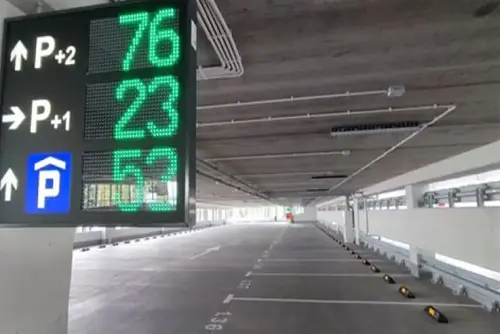
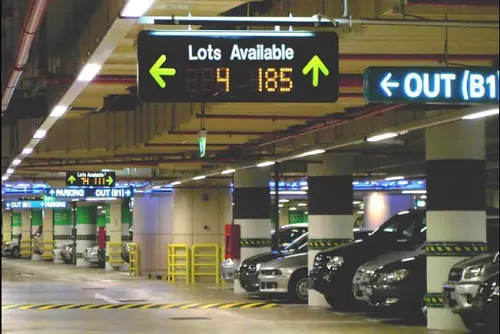
An indoor parking space indicator lights guidance display screen is a visual gadget that indicates the current parking space availability and direction. It has three typical levels. Single-space indications are green when open and red when occupied so that a motorist may observe the condition of each bay from a distance. Zone displays include arrows that indicate the number of free spaces in an aisle or area. Displays at entrances and ramps indicate to cars which level has space. Reserved, accessible, or EV bays might utilise different symbols or colours. Most garages have a combination of two or three levels since each one addresses a distinct issue for the motorist.
From Sensor to Driver
Information transfers in five steps: Sensor → Controller → Software Platform → Display → Driver Action. Sensors, often ultrasonic, video, magnetic, or radar, sense the presence or absence of an automobile in a bay. The data is sent to a controller via a wired, wireless, or mixed network where it is processed and each status is synchronised. The software platform then transmits the result via LED signs, LCD panels or floor counters. The motorist scans the colour or number and chooses a direction. An indoor parking guidance display screen only displays what its data tells it; therefore, a poorly targeted sensor or an unreliable network leads to erroneous figures. People quit believing an indication that is inaccurate.
Industry Terms You Will See in Quotes
Suppliers use a variety of names for comparable items. The whole collection of sensors, controllers, and indicators is commonly called a parking spot availability display system. An ultrasonic parking guidance display screen is an indicator controlled by ultrasonic bay detectors. An LED parking guide sign identifies the light source. The whole system is known as a parking guidance and information system or PGIS. Each bidder should provide its conditions in writing. A price for only a sensor and a price for a complete system might appear the same on paper yet cover vastly different scopes. First compare the line items for the indoor parking guidance display screen, and then the sensors and software.
How Green and Red Occupancy Indicators Reduce Search Time
Color Signals Speed Up Decisions
Green signifies go, red implies no-go. A motorist sees free bays in a second. They pass a series of illuminated indicators, nothing to read, no need to check for a space between parked automobiles. Red lights reduce the need to check occupied bays, reducing the stop-and-look behaviour that slows aisles. Colour coding is also a good idea if you have a dark garage, or for guests who don’t speak the local language, such as airport travellers. Use the same scheme on each level. If blue indicates accessible on one level, it should have the same meaning elsewhere. A clear interior parking guidance display screen layout relies on such uniformity.
Zone and Floor Counts at Decision Points
When you go to an aisle, bay lights help. Drivers need advice to choose the aisle before that. Counters at entrances, ramps, crossroads, and elevator lobbies for zone and level tell you how many spots are ahead of you. A display showing "Zone A: 5" and "Zone B: Full" allows a car to bypass Zone B without going into it. This is extremely important during peak hours, when one popular zone fills up first, and traffic backs up behind it. Signs divide the load and keep lanes flowing by directing drivers to areas with space. Our ZOJE-31-1/2/3 model, in fact, is designed to provide zone-specific instruction.
Measuring What an Indoor Parking Guidance Display Screen Delivers
"Don't guess whether the system works. Set a baseline before installation. Avg time from entrance to parked. Circulation loops. Ramp wait duration. Occupancy by zone. Driver complaints. Post-commissioning, look at the same weekdays, weekends, and peaks. For on-street parking, the San Francisco Municipal Transportation Agency’s 2014 pilot study of SFpark used a before-and-after design with pilot and control sections. Garage operators may use the trick. If benefits don't pan out, look at sign location, brightness, sensor alignment, and communication settings before criticising the idea.
Benefits and Technology Choices for Indoor Parking Guidance
Benefits for Drivers and Operators
Drivers face reduced uncertainty and shorter travel through the facility. Operators are seeing more consistent use of floors, less waiting on ramps, and less need for personnel to manage traffic. A linked indoor parking advice display screen system may also be used to record occupancy information and historical records. They help with capacity planning, peak hour analysis, and maintenance scheduling. The level of detail in the reports varies according to the software platform you choose and the extent of integration, so ask to view sample reports before you buy. The data reveals the distinct peak patterns for malls, airports, hospitals, hotels, and office buildings.
Comparing LED, LCD, Sensors, and Networks
Green and red bay lights, space counts, LED suits. High-visibility status signs. LCD is ideal for maps, multilingual instructions, and branded information. Privacy problems are eased by ultrasonic sensors, which identify bay occupancy without the need to capture photos. Cameras have a greater range but need adequate illumination and the right settings for the analytics. Wired networks provide a solid long-term basis. Wireless connectivity makes it easier to refit when pulling cable is difficult. The only winner is no name. Whichever indoor parking space indicator lights guidance display screen you choose, evaluate it on the basis of accuracy, site circumstances, integration, maintenance, and total cost of ownership.
Guidance for Special Spaces
Need distinct symbols and consistent colours for EV charging, accessible, family, VIP and cargo facilities. Before turning in, vehicles know what a bay is for thanks to a wheelchair emblem or charging indicator. Use symbols people will recognise without a tale and put them at eye level so headlights won't wipe them away. Durability is important, however. Garages are covered in brake dust and exhaust soot, so check with providers regarding enclosure protection and cleaning access. Maintenance crews also need a quick means to detect fault statuses, so that a dead sensor doesn't leave a false green. Make sure your system can deal with each status type you want to employ.
Choosing and Installing an Indoor Parking Guidance Display Screen
Buying Checklist
First record the site – number of spaces, number of levels, zones, height of ceiling, lighting, ventilation, retrofit or new construction. Then compare detection accuracy, reaction time, brightness, viewing angle, communication protocols, power consumption, protection rating, fault indications, and local electrical compliance. Confirm interoperability with access control, license plate recognition, tickets, EV charging, and mobile applications. Price not just the sign but the full package including software, installation, training, replacement parts and warranty. A buyer who studies every indoor parking advice display screen quote line by line avoids surprises later on.
ZOJE-31-1/2/3 and Manufacturer Support
ZOJE-31-1/2/3 is our indoor parking advice display screen for indoor facilities. It has a high-brightness LED display, for easy viewing inside, with red and green indications for space status. A central controller syncs data so empty-space counts are updated in real time. RS485 or TCP/IP choices assist in tying the screen into current parking systems, and stable wireless transmission eliminates the wiring headache for retrofit works. It has permanent operation with a 32-bit ARM CPU. Hong Kong ZOJE Intelligent Technology Co., Ltd. was established in 2012 and is located in Shenzhen. The company has developed various patents and is manufactured according to ISO 9001:2015 quality management. Standard items are available in 5-7 days and customised products in 10-15 days. We also offer OEM & ODM projects, a 2-year guarantee, and 24/7 technical assistance.
Installation and Acceptance
A site survey is the first step of a typical project. Engineers pinpoint where entrances, ramps, crossroads, zones, pedestrian ways, cable pathways, and where cars become confused. Next, the team installs sensors, indicators, zone displays, floor counts, controllers, and software and gives an ID to each location. Tests must include the following states: available, occupied, reserved, fault, and communication loss. Acceptance tests detection accuracy, response speed, readability, network stability, and reports. Staff training and a strategy for preventative maintenance complete the task. Document each step so that your indoor parking guidance display screen passes off smoothly to the facilities staff.
Conclusion
Static signage can’t tell drivers whether bays, zones, or levels are open, and drivers waste time in interior garages. An indoor parking guidance display screen takes care of that by translating sensor data into green and red signals, space counts, and pointers that drivers see at a glance. This article discussed the flow of data from the sensor to the controller, software, and display. It also highlighted how zone and floor counters reduce aisle-by-aisle searching, and how LED, LCD, ultrasonic, camera, wired and wireless selections are based on accuracy, site circumstances, integration and overall cost. Buyers should record the site, compare full-scope quotes, test every state throughout acceptance, and compare baseline and post-installation search speeds. Measured outcomes reveal whether guidance worked
FAQ
1. What is an indoor parking guidance display screen?
It is a visual device that shows live space availability and direction. Sensors and a controller feed it, and it uses green and red signals, space counts, and arrows.
2. How does ultrasonic detection work?
A sensor sends sound pulses toward a bay and reads the echo. A parked car changes the return time, so the controller marks the space occupied.
3. When should I choose LED or LCD for an indoor parking guidance display screen?
Choose LED for bright status signals and space counts. Choose LCD when you need maps, multilingual text, or branded content.
4. Why do project prices differ?
Space count, floors, sensor type, software scope, site conditions, and customization all change the total. Request a site-specific quotation.
Request an Indoor Parking Guidance Display Screen Quote from ZOJE
Planning a new garage or upgrading an existing one? Send ZOJE your space count, floor layout, sensor preference, display needs, destination market, and delivery date at info@zoje-tech.com. As an indoor parking guidance display screen manufacturer, we can prepare a system layout, product options, and a project quotation, with OEM or ODM support if you need it.
References
1. Cruising for Parking, Transport Policy, 2006
2. The High Cost of Free Parking, Planners Press, 2005
3. A Survey of Smart Parking Solutions, IEEE Transactions on Intelligent Transportation Systems, 2017
4. An Integrated Model of Downtown Parking and Traffic Congestion, Journal of Urban Economics, 2006
5. SFpark: Pilot Project Evaluation, San Francisco Municipal Transportation Agency, 2014
6. Parking Management Best Practices, Planners Press, 2006

Send Inquiry
You may like