
How to improve the detection accuracy of Vehicle Loop Detector for Gate?
2026-07-06
Improving the accuracy of vehicle loop detectors means making sure they are installed correctly, fine-tuning their sensitivity settings, and following regular repair procedures. Concerns about accuracy can be eased with a high-performance Vehicle Loop Detector for Parking Management System like the ZOJE-LD132. It has auto-tuning technology, an Advanced Signal Boost (ASB) mode, and frequency settings that can be changed to reduce crosstalk. Electromagnetic field detection works best when loops are the right size, the wiring is of good quality and insulated properly, and the sensors are placed strategically under barrier gates. Regular system tests with LED signs help find problems early, and professional tuning keeps things running at their best in a wide range of settings, from the entrances to shopping malls to multi-level airport parking structures.
Understanding the Challenges in Vehicle Loop Detector Accuracy
Vehicle loop monitors have a lot of problems with accuracy that affect how well gates work and how efficiently parking lots work. Knowing about these problems helps facility managers and procurement workers come up with specific answers.
Environmental Factors Affecting Detection Performance
Temperature affects inductive loop devices. Extreme heat and cold may stretch and shrink pavement, damaging subterranean loop wires. Saw clippings lose insulation when wet. Low signals might create missing or false triggers. Underground parking is usually moist, accelerating wire deterioration. EMI from nearby power lines, electrical equipment, and radio frequency sources skews automobile loop detector inductance values. EMI is high in electrically equipped malls and airports with communication systems. Noise filtering effectiveness influences identification efficiency in these conditions.
Installation-Related Accuracy Issues
Poor installation causes most detection problems. Loop size matters. Large loops can take up close metal products, but not trucks. Commercial parking lots with delivery trucks need bigger loops than 6-foot by 6-foot ones for cars. Quality and depth of burial effect wire life. Substandard insulation may break down in months when exposed to fuel, road salt, or alkaline concrete chemicals. If used appropriately, XLPE (cross-linked polyethylene) insulated wire may last for years in these harsh circumstances. At 1.5 to 2 inches, electromagnetic field production is optimal without surface damage. Problems may emerge while routing the loop-to-detecting unit lead-in cable. Twisted-pair wires reduce electrical noise, however grounded or unprotected transmissions may be affected. Loop signal strength and accuracy decrease with distance from detecting devices.
Configuration and Sensitivity Challenges
Each application needs accurate sensitivity calibration. Private gates and shopping centers have different admission restrictions. If sensitive enough, shopping carts, motorcyclists, and large metal carriers may cause false alarms. It cannot identify small cars or bicycles due to limited sensitivity. Multiple lanes need the right frequency. Crosstalk occurs when detectors share frequency. This means that one detector detects adjacent-lane cars. Modern systems have several frequency channels, but setup skips this phase. Gate safety and traffic flow are affected by response time. Barrier gates must have a presence recognition mode to sustain output signals while cars are in the loop zone. Ticket machines need pulse detection to momentarily activate when a vehicle arrives. When recognition modes don't match, operations fail, frustrating customers and slowing facilities.
Technical Principles Behind Vehicle Loop Detectors and Their Accuracy
Knowing how inductive loop technology (Vehicle Loop Detector for Parking Management System) works on a technical level helps buying teams choose the right options and fix accuracy problems quickly.
Inductive Loop Technology Fundamentals
Auto loop monitors employ electromagnetic induction. An oscillating current from the detecting gadget creates a magnetic field above ground via the buried wire loop. Eddy currents alter loop inductance when car frame metals enter this area as secondary conductors. The detector continually detects inductance, ranging from 20 to 1000 µH, based on loop size and wire turns. Vehicles change inductance 0.01%–2.5%. Events are detected when changes surpass limits. The sensitivity range (ΔL/L) shows the system automatically detects certain vehicle kinds. Stable oscillator frequency affects accuracy. Good monitors keep frequency drift below ±5% over -40°C to +85°C temperature range. Daytime weather changes cause cheaper devices to wander, creating false alerts or missed detections. Industrial-grade ZOJE-LD132 components stabilize motion in demanding environments.
Detection Modes and Their Applications
Presence recognition helps avoid boom closures by watching vehicles near barrier gates. The monitor maintains relay output throughout car loops. This mode requires careful sensitivity setting. Too low sensitivity may close the gate rapidly and dangerously, while too high can keep the output on after the vehicle departs, delaying gate operation. Ticket scanners and access control systems use pulse recognition for short-term triggers. The detector quickly activates and continues when a vehicle arrives. This mode saves electricity by reducing relay cycles and works well for busy entry lanes. ASB mode finds concealed cars. Standard detection systems don't always detect high-bed trucks, trailers, or vehicles with little metal under the body. After recognition, ASB mode boosts sensitivity to detect the whole car passage. ASB technology in the ZOJE-LD132 adapts to commercial parking lot vehicles.
Comparative Technologies and Their Accuracy Profiles
Pressure-based sensors are easy to install without breaking the pavement, but they are inaccurate when materials move due to freezing and thawing. Slow cars with low pressure differential can't pick up lightweight bikes, therefore these strategies fail. Infrared photoelectric sensors work well inside with controlled lighting. Outside in fog, rain, or high sunlight, they are less accurate. Except for magnetic loops, optical systems work best when cleaned routinely. Video recognition from a camera may cover several lanes. Lighting, camera positioning, and software affect accuracy. These devices scan license plates effectively yet miss some cars at night or in bad weather. Initial costs are higher than loop detectors, but placement may be cheaper.
Inductive loop detectors are the best barrier gate safety application since they work in all weather, lighting, and car colors. Permanently open airports and malls need loop technology to function in any weather.
Proven Methods to Enhance Detection Accuracy
Using organized methods for setup, configuration, and upkeep improves the accuracy of car loop detectors over the entire lifetime of the system.
Optimal Installation Practices for Maximum Accuracy
The shape of the loop has a big effect on how consistently recognition works. When it comes to sensitivity, rectangular loops are even across the detecting zone, while circular loops focus sensitivity in the middle. The entry lanes are set up in rectangles that are 6 feet wide and 6 feet long to accommodate normal car wheelbases. Mixed-traffic exit lanes should have 8-foot-by-6-foot rings to make sure that longer cars can be reliably found. The wire turn count (Vehicle Loop Detector for Parking Management System) strikes a balance between inductance and ease of fitting. Three to five turns usually give 100 to 300µH of inductance, which is good for most stopping situations. For commercial buildings that serve heavy cars, the loops may need to be bigger and have more turns to hit 400–600µH, which is the right level of electromagnetic field strength for high-clearance vehicles.
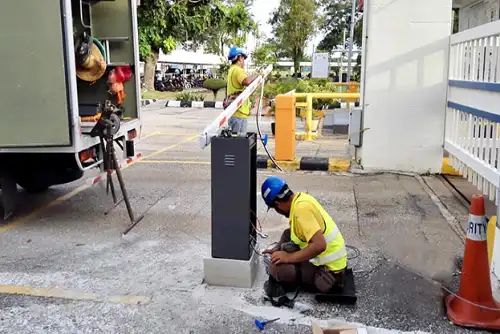
To fix something correctly, you must first make clean cuts with a saw that are 1/4 inch to 3/8 inch wide. Before putting in the wire, installers should clean up any dirt or wetness and seal any cuts with polyurethane or epoxy compounds that are flexible enough to allow for ground expansion. A good barrier stops water from getting in, which, over time, makes detection less accurate. Professional construction teams follow these important steps to make sure long-term dependability:
- Saw Cutting Precision: Diamond-blade saws made for concrete or asphalt can be used to make cuts that are straight and even. Instead of sharp angles, corners should have gentle bends that make it easier to place wire insulation and then allow the ground to move.
- Wire Installation Technique: Carefully feed the wire into the cuts without putting too much stress on it, which could damage the insulation. Instead of pulling the wire tight, leave a little extra space around it. This lets it expand with heat without creating stress points. Instead of sharp tools that could cut the insulation, use wire guides or tools with a round end.
- Lead-in Cable Protection: From the loop edge to the detector site, run twisted-pair lead-in wires through secure conduit. The right conduit keeps repair tools from damaging the ground and protects wires from electrical interference. Ground the wire only at the end that connects to the detector. Having more than one ground point creates ground loops that make noise.
- Connection Quality: Instead of using crimp connectors, which can rust or come loose over time, solder and heat-shrink all wire connections. To get the best noise protection, double-check the polarity and make sure that the twisted pairs stay in the same shape throughout the wire run.
The careful steps used during installation lay the groundwork for accurate tracking that will last for years. If facilities don't do these things, systems break down early, which costs a lot of money and causes system downtime.
Advanced Calibration and Configuration Techniques
Automatic tuning simplifies setup and assures a perfect standard configuration. When turned on, the ZOJE-LD132 detects loop inductance and adapts its settings to fit the installation. It removes manual tuning, which needs test equipment and technical skills. Adjusting sensitivity matches different cars and needs. Residential parking arrangements for cars are less sensitive to motorcycles and motorbikes. Commercial buildings that accept all vehicles need higher sensitivity and frequency selection to avoid metal structure triggers.
In multi-monitor systems, frequency selection reduces interference. The ZOJE-LD132 changes frequency settings to let neighboring devices utilize different channels. To avoid confusion, use different frequencies for entry and exit lanes within 10 feet. Plan installation regularity to avoid traffic pattern-specific accuracy concerns. Drift correction automatically adapts detection limits to environment changes. Daytime pavement temperature variations little affect inductance. Quality detectors update baselines after these little changes. They retain detection accuracy without manual calibration. Outdoor parking spaces with big morning-afternoon temperature changes benefit from this flexibility.
Routine Maintenance and Troubleshooting Strategies
Machines live longer and operate better with regular maintenance. Visual inspections every three months identify loop sealant breakdown before water damages wire insulation. Every two to three years, freeze-thaw facilities should reseal. LED diagnostics provide device status in real time. ZOJE-LD132 LEDs show power, events, and loop faults. Maintenance workers may detect flaws without expensive test equipment by looking at indication patterns. Electromagnetic interference or sensitivity misconfiguration may keep the identification light on without a car. The loop or monitor breaks if no cars are spotted.
Megohm inductance meters may discover wire shielding difficulties. Insulation resistance between loop wires and ground should reach 100 megohms annually. The loop must be replaced before it falls below 50 megohms due to insulation failure. Peak operation detection problems are avoided with this proactive technique. Long-term system management benefits from thorough documentation. During construction, maintenance teams should record loop size, wire specs, detector settings, and frequency allocations. This helps when trying to figure out what's wrong months or years later, especially after recruiting new staff. You may set up several lanes consistently and arrange modifications with accurate records.
Comparative Analysis: Selecting the Best Vehicle Loop Detector for Your Parking Management Needs
To pick the right recognition technology, you need to look at a number of things that affect its accuracy, dependability, and total cost of ownership in different types of parking lots.
Wired Versus Wireless Loop Detector Systems
Traditional wiring connects detectors with twisted-pair cables. This delivers messages reliably without batteries. Conduit from loop sites to equipment rooms increases installation costs but eliminates battery changes. For high-stakes barrier gate safety, wire systems provide constant signal integrity. Wireless system loops without conduit use battery-powered emitters to communicate with central receivers. These designs reduce retrofit installation costs when pipe cutting is difficult. The battery lasts 3–5 years, depending on detection frequency and environment. Wireless data transmission may be confused in high electromagnetic fields like shopping mall loading docks or industrial goods facilities, reducing signal accuracy. Permanent installations with accessible equipment rooms are more dependable with wired systems. Wire designs endure decades, making office and apartment garages better. Wireless solutions that are portable and need minimal infrastructure are ideal for temporary events and construction sites.
Feature Comparison: Industrial-Grade Versus Economy Detectors
With additional features, industrial monitors are more accurate and simple to maintain. Many ZOJE-LD132 characteristics are business-oriented. While retaining ideal baseline settings, auto-tuning speeds installation. Budget mode misses uncommon autos, ASB discovers them. Frequency modifications may eliminate multi-lane interference in fixed-frequency detectors. Single-output economy models have fewer applications than double-relay outputs. Barrier gates and counting systems may use the same detector, lowering equipment costs and simplifying system design. Since entrance lanes require safety loops beneath barrier arms and activation loops in front of ticket machines, this configuration favors shopping center business parking lots.
From stateless monitors, LED diagnostic indicators detect industrial equipment. Installation teams may evaluate functionality using real-time visual input, reducing commissioning time. Maintenance staff may find issues without testing. System downtime decreases, enhancing building performance and customer satisfaction. Industrial-grade polyamide housings and conformal-coated circuit boards can withstand harsh conditions. Extreme heat, humidity, and corrosion damage inexpensive subterranean parking infrastructure in months. The ZOJE-LD132 has performed successfully in harsh environments for years due to its practical design. Southern airport and corporate parking lots are -40°C–+85°C. Economy detectors like little traffic, light household usage, and safety. Single-family residential gates and small commercial parking lots may use basic features. Industrial-grade equipment reduces costly downtime and safety hazards in heavy-traffic enterprises.
Warranty, Support, and Total Cost Considerations
A 2-year guarantee protects funds, operations, and hazards. The ZOJE-LD132 has a full guarantee and 24/7 global support. Fast repairs and less financial risk when equipment breaks down are guaranteed by this service agreement. Tech support affects system uptime more than equipment cost. Installers, configurers, and troubleshooters outperform sellers. ZOJE Intelligence Technology has parking lot experts since 2012.
Delivery times effect project and operating preparedness. Emergency building deployments or replacements may get standard items in 5–7 days. Custom solutions require 10-15 days for heavy-duty industrial goods facilities that need higher EMI shielding. Choosing delivery helps purchasing teams balance urgent and distinctive demands. The entire ownership cost surpasses the purchase price. Also included are installation, maintenance, and product lifespan. Correct monitors reduce gate closure mistakes that harm automobiles and put owners at risk of lawsuit. Reliable monitoring decreases staff-wasting support calls and customer complaints. Though more expensive initially, instruments that last 10-15 years instead of 3–5 years cost less over time.
Real-World Case Studies: Improving Detection Accuracy in Gate and Parking Systems
Practical implementation examples demonstrate how systematic improvements in accuracy lead to real practical gains in a range of parking facility types.
Shopping Mall Parking Facility Transformation
A regional shopping mall has barrier gate crashes and slow lanes. The first installation used economy detectors with one output and sensitivity. Loops under barrier arms increased safety, but those before ticket machines didn't work. The gates opened before all tickets were collected, inviting tailgaters and decreasing income. A number of building management changes improved accuracy. Using XLPE-insulated wire and expert fitting, several water-leaking loops were replaced. Upgraded ZOJE-LD132 detectors with twin relays enabled cooperative control. The gate opened quickly following ticket confirmation. Frequency adjustments removed fake triggers from entry lane interference.
ASB mode discovered delivery trucks and service vehicles with high clearance or little metal underbody parts. Auto-tuning eliminates monthly manual sensitivity slip correction. Technicians can fix problems without outside help using LED diagnostic signals. Vehicle Loop Detector for Parking Management System findings changed significantly during six months. Gate accidents reduced 87%, eliminating costly car damage and liability claims. Because ticket distribution was quicker and more reliable, entrance lane throughput increased by 34%. Facility surveys showed measurable customer pleasure increases. Fewer service calls and immediate solutions reduced maintenance expenditures by 62%.
Multi-Level Airport Parking Structure Optimization
Short-term and long-term customers have trouble entering and leaving a five-level international airport parking complex. As the plant developed, early detection systems employed several technologies over a decade. Some gates opened early and others late due to identification issues, slowing rush-hour traffic. Environmental issues included extreme temperature differences between enclosed lower levels and uncovered upper decks. EMF from radio and airport radar makes identification tougher. Standardize all construction gear, setup, and maintenance. Industrial-grade devices with powerful EMI filtering were employed to deploy the system from the busiest access points. Frequency switching controlled 12 entrance and 8 departure lanes on the ZOJE-LD132. Repair technicians found the problem by recording each lane's frequency in facility data.
Professional assembly teams adjusted loops to standard (6x8 feet, 4 wire turns, 250-300µH inductance). Ground and shield lead-in wires to reduce airport electrical interference. Systematic drift correction preserved sensitivity during basement-outside parking temperature variations. Schedule annual inductance testing, quarterly inspections, and maintenance. Airport maintenance staff learned to swiftly detect problems using LED signage. All lanes were consistent due to diligent recordkeeping. We witnessed quick operational changes. Found 99.9% of lanes. This prevented early gate closures, which damaged rental automobiles and caused liability claims. Traffic increased 28% with quicker, more frequent gate cycling. Operational awards improved airport service.
Conclusion
To make car loop detectors more accurate, you need to pay close attention to how they are installed, how they are set up, and how they are maintained regularly. Knowing the basic ideas behind inductive loop technology helps you choose the right tools and figure out how to fix problems. Long-term detection effectiveness is affected by environmental factors, electromagnetic interference, and placement methods. Industrial-grade detectors like the ZOJE-LD132 are more accurate because they have advanced features like auto-tuning, ASB mode, frequency settings that can be changed, and dual-relay outputs that solve common operating problems. As a Vehicle Loop Detector for Parking Management System, it is designed to deliver stable detection performance across different traffic environments. When facilities use complete strategies to improve accuracy and back them up with high-quality tools and professional technical support, they see measurable gains in safety, throughput, customer happiness, and maintenance costs.
FAQ
1. What maintenance intervals ensure optimal vehicle loop detector performance?
Visual checks every three months find sealer wear and surface damage before they make detection less accurate. Using megohm meters to check the inductance of wires once a year ensures that the insulation stays above 100 megohms. In tough areas, reapplying sealant every two to three years stops water from getting in. Configuration drift is caught early by checking the detector settings and LED warning patterns once a month.
2. How long do vehicle loop detectors last in commercial parking environments?
When installed and kept properly, industrial-grade detectors usually work regularly for 10 to 15 years. Loop wire can last anywhere from 7 to 12 years, based on the location, the amount of traffic, and how well it was installed. Economy monitors might need to be changed every three to five years. Harsh conditions with freeze-thaw cycles, a lot of traffic, or chemical contact shorten the life of parts.
3. Do wireless loop detectors match wired system accuracy?
In normal situations, wireless systems are about as accurate as wired systems, but they are more likely to be affected by electromagnetic radiation in places with a lot of electricity. Maintenance for batteries adds practical concerns that aren't present in wired setups. For critical safety uses at barrier gates, wired setups usually work best because they are the most reliable. Wireless systems work well for short-term installs or retrofits where installing pipe is not an option.
Partner with ZOJE for Reliable Detection Solutions
ZOJE Intelligence Technology offers tried-and-true car loop detector systems with full technical help and the best warranty coverage in the business. Our ZOJE-LD132 Vehicle Loop Detector for Parking Management System has industrial-grade parts, auto-tuning technology, and an ASB mode that make sure it works correctly in a wide range of business settings. We've been making things since 2012 and have a lot of experience. We can support custom setups, OEM partnerships, and full system integration for airports, shopping malls, residential communities, office buildings, and business parking lots. Email our team at info@zoje-tech.com to talk about your particular needs and get full technical specs. We offer world support 24 hours a day, seven days a week, professional installation help, and a two-year guarantee.
References
1. Transportation Research Board. "Detection Technology for Parking Management and Revenue Control Systems." National Academy of Sciences, 2018.
2. International Parking Institute. "Best Practices in Vehicle Detection Technology: Installation and Maintenance Guidelines for Commercial Facilities." Professional Development Series, 2020.
3. Institute of Electrical and Electronics Engineers. "Standards for Inductive Loop Vehicle Detectors: Accuracy Requirements and Testing Protocols." IEEE Transportation Systems Technical Committee, 2019.
4. National Parking Association. "Comparative Analysis of Vehicle Detection Technologies in Multi-Level Parking Structures." Industry Research Report, 2021.
5. American Society of Civil Engineers. "Guidelines for Installation and Maintenance of Inductive Loop Detectors in Parking and Gate Applications." Infrastructure Systems Division, 2019.
6. International Organization for Standardization. "Vehicle Detection Systems: Performance Specifications and Quality Control Methods for Parking Management Applications." ISO Technical Standards Document, 2020.

Send Inquiry
You may like

Related Industry Knowledge
- How Does Radar Vehicle Presence Sensor for Barrier Gate Work
- Parking Management Barrier Gate Features & Integration
- High-Speed Access Control Turnstile Gate Features
- Bridge-Style Tripod Turnstile Benefits in Office Security
- How Bridge-Style Tripod Turnstile Improves Access Control?
- How Unattended Access Control Turnstile Works?
- Best Bridge-Style Tripod Turnstile for Commercial Entry
- Top Benefits of Collision-Proof Boom Barrier Systems
- Can License Plate Recognition Reduce Parking Costs?
- How Compliance-ready and Regional ANPR System Ensures Data Compliance?